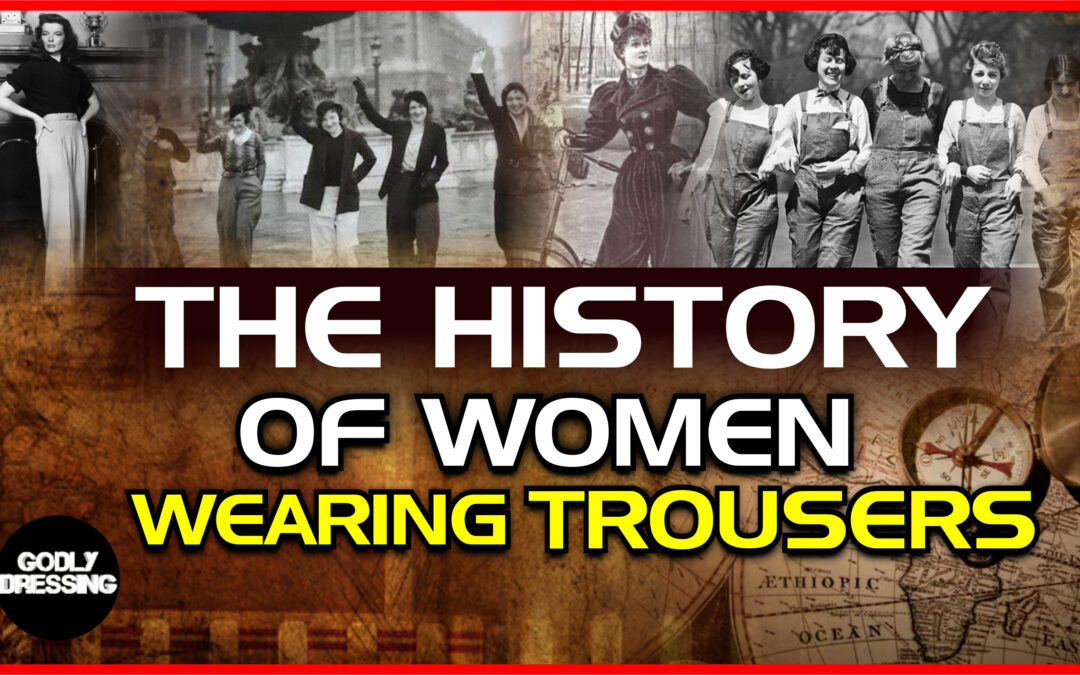
The History of Women Wearing Trousers: A Comprehensive Overview
The journey of women adopting trousers—often slowly, controversially, and against societal pressure—reveals
deep shifts in culture, identity, and gender norms. This article presents a comprehensive historical overview
with verifiable references.
1. Early Instances: Pre-Modern and Non-Western Traditions
Although many Western societies associated trousers strictly with men, several ancient cultures allowed—and even
expected—women to wear trouser-like garments.
- In ancient China, women commonly wore ku, a pant-style clothing suitable for horseback riding and field labor.1
- In the Ottoman Empire, women wore loose pantaloons known as şalvar, especially in rural areas where mobility mattered.2
These examples show that trousers were not inherently “male” apparel globally; rather, this perception was culturally
specific to certain regions—especially Western Europe.
2. The 19th Century Dress Reform Movement
The Birth of the “Bloomer”
A major turning point began in 1851, when Elizabeth Smith Miller introduced the “Turkish dress,” consisting of
pantaloons worn under a shorter skirt.3 Amelia Bloomer, editor of the women’s rights newspaper
The Lily, championed the garment so strongly that it soon became known as “bloomers.”3
Influential women such as Elizabeth Cady Stanton and Susan B. Anthony also adopted bloomers, calling them the
“freedom dress” because they allowed mobility that long, heavy Victorian skirts restricted.3
Working Women and Practical Clothing
Outside activism, trousers also emerged among working-class women for practical reasons. In the coal pits of Wigan,
England, “pit brow women” wore trousers beneath shortened skirts to work safely and efficiently. Their clothing drew
public shock, and photographers documented their unusual attire throughout the 1800s.4
3. Early 20th Century: Fashion Innovation and World Wars
The early 1900s saw designers challenge traditional norms. In 1913, French designer Paul Poiret introduced
harem-style trousers for women, inspired by Middle Eastern attire.5 Though controversial, the designs
planted the seeds of acceptance in fashion culture.
World War I and World War II
Global wars accelerated societal change. During World War I, women entered factory work in large numbers, adopting
trousers for safety and practicality.6 The trend expanded during World War II, where millions of women
in factories, shipyards, and farms wore trousers daily.6
For the first time, trousers became widely normalized for women, even if many returned to skirts after the war.
4. Mid-Century Shifts: Feminism, Fashion, and Public Policy
The Rise of the Pantsuit
The feminist movements of the 1960s and 1970s pushed trousers from being merely “practical” to becoming
symbolic. In 1966, designer Yves Saint Laurent debuted the iconic “Le Smoking” tuxedo suit for women—an
empowering statement that trousers could be formal, elegant, and feminine.7
Breaking Political Barriers
Many institutions resisted women wearing trousers well into the late 20th century.
- In 1969, U.S. Representative Charlotte Reid became the first woman to wear trousers on the floor of the U.S. House of Representatives.8
- In 1993, the U.S. Senate finally lifted its ban on women wearing trousers after Senators Barbara Mikulski and Carol Moseley Braun appeared in pantsuits.8
5. Legal Restrictions Persisting Into the 21st Century
France’s 213-Year Ban
A forgotten law from 1800 technically required Parisian women to obtain police permission before “dressing as
men,” including wearing trousers. Although unenforced, the law was officially repealed only in 2013.9
Sudan’s Public Order Laws
Until 2019, Sudanese authorities could punish women for wearing trousers under strict Public Order regulations.
Its repeal marked a major milestone for women’s rights activists.10
6. Contemporary Symbolism and Global Variations
Today, trousers are widely accepted as normal attire for women globally. The pantsuit, in particular, has come to
symbolize authority, professionalism, and gender equality.
Yet in some conservative or traditional societies, women wearing trousers still face criticism, showing that while
the debate has diminished, it has not entirely disappeared.
Over centuries, trousers have evolved from a practical garment to a powerful cultural statement—symbolizing autonomy,
dignity, and freedom.
Conclusion
The history of women wearing trousers is not simply a shift in fashion; it is the chronicle of women challenging
boundaries, entering male-dominated spaces, and insisting on mobility and equality. From ancient civilizations to
modern political halls, trousers have become a lasting symbol of empowerment.
Footnotes / References
- Ancient Chinese female clothing traditions – RTE: A Brief History of Women and Trousers.
- Ottoman women and the şalvar – RTE: A Brief History of Women and Trousers.
- Dress reform movement, Amelia Bloomer, Elizabeth Smith Miller – Wikipedia: Trousers as Women’s Clothing.
- Pit brow women of Wigan – Wikipedia: Trousers as Women’s Clothing.
- Paul Poiret’s harem pants – Wikipedia: Trousers.
- Women wearing trousers during WWI & WWII – Wikipedia: Trousers as Women’s Clothing.
- Yves Saint Laurent “Le Smoking” suit – RTE: A Brief History of Women and Trousers.
- U.S. Congress acceptance of women wearing trousers – M.M. LaFleur: A History of Women and Pants.
- Paris repeals its 1800 trouser ban – The Guardian, 2013.
- Sudan’s repeal of restrictive clothing laws – International news reports, 2019.